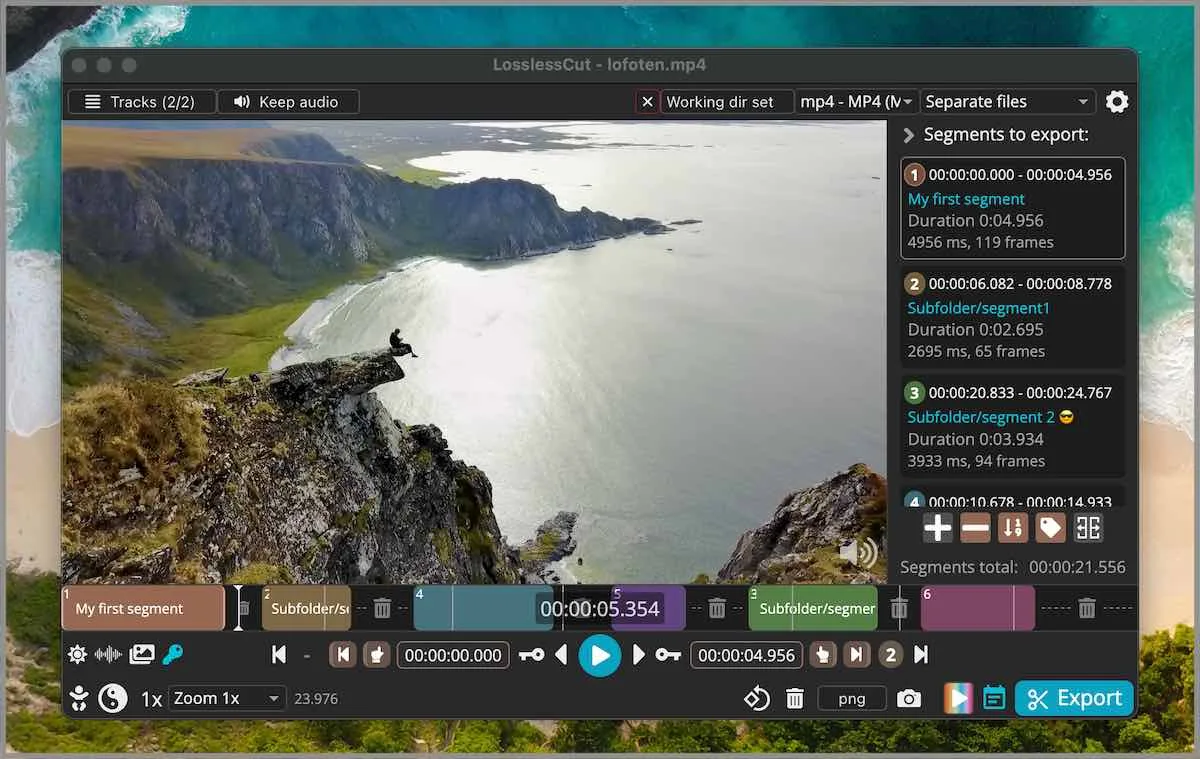
Default cut is codec copy
LosslessCut default export copies the bitstream. In and out points align to keyframes. Extra frames can remain at the in-point. That is the lossless trade. README and issue 126 mark smart cut as experimental. Related: keyframe cuts, guides, home, this computer. Product homepage: losslesscut.app. License: GPL-2.0.
People who already type FFmpeg -c copy know this seam. The GUI is preview and in/out points of the same idea. Leave the default on until a throwaway proves you need the experimental path.
What smart cut tries to do
Smart cut tries to re-encode only a small part around the in-point so the cut can sit off a keyframe, then copies the rest. That is still a re-encode of that part. It is not a HandBrake preset on the whole file. It is not Shotcut filters. Compare: versus HandBrake, versus Shotcut.
The rest of the file stays a bitstream copy when the mode works. The small re-encode is the cost of a tighter in-point. That cost is why the default remains keyframe copy.
A GOP is a keyframe plus the predicted frames that follow it. Default codec copy cannot start in the middle of that group, so extra frames remain at the in-point. Smart cut tries to encode a new short GOP for that opening stretch, then splice back to the copied bitstream. When the splice works, the in-point is closer to the frame you marked. When it fails, you can see a freeze, a desync, or a worse skip than the default cut.
Issue 126 is still the place to read current reports. These notes do not freeze a dotted version around that issue. Experimental on the README is the status that matters.
Issue 126 and experimental status
Issue 126 is the long-running smart-cut thread. README calls the mode experimental. Experimental means it can fail on some codecs, some containers, some GOP structures. It can look worse than a keyframe cut. It can leave an audio skip. Notes skip promising a silent join.
Test a throwaway. Keep the original. If the test looks wrong, leave smart cut off. Wedding files, camera masters, and anything you cannot recapture are keep files. Throwaway screen recordings are the right test bed.
When to leave it off
Leave it off when you need a guaranteed codec-copy export, when the extra frames at the in-point do not matter, or when the codec is one you have not tested. Audio skip at a codec-copy cut is a related seam. Smart cut may hide it or may not. If audio skips, read issue threads on the repo rather than inventing a flag. Issues: lossless-cut issues.
Keyframe detail sits on its own page: keyframe cuts. Merge of several cuts still follows those rules: merge segments.
Crop, resize, and other encodes
Crop honesty sits next to smart cut. README Features lists lossless crop and aspect ratio modification. The FAQ still groups crop, resize, and stretch with lossy re-encode and points at issue 372. Treat lossless crop as bitstream copy when the app actually does that. Treat resize, stretch, and filters as encodes. Crop URL: video cropper. Trim: trim video. MP4: mp4 trimmer. Cutter: video cutter.
| Mode | What it does | Risk |
|---|---|---|
| Default keyframe cut | Codec copy. In-point on a keyframe. | Extra frames at the in-point |
| Smart cut | Experimental. Re-encodes a small part. | Can fail. Test a throwaway. Issue 126. |
| HandBrake whole-file encode | Compress the entire file | Size pass, not a lossless cut |
| Shotcut timeline | Effects NLE, re-encodes | Wrong tool for a lossless trim |
| Lossless crop | README lists it | FAQ still hedges with issue 372 |
| Resize / stretch / filters | Re-encode | Not codec copy |
Install from GitHub, then test
Windows: LosslessCut-win-x64.7z, extract with 7-Zip. Windows. macOS: matching dmg. macOS. Linux: GitHub AppImage or tar. Linux. Snap is supporting only. Safe fetch: download safely. 7z versus store: 7z or store. GitHub stays free. Store listings lag.
Settings live in the OS app data folder. .llc files sit next to the media unless you turn them off. The app is not an NLE. FAQ and issue 976 say segments on a timeline, export those portions.
After a smart-cut export
Play the file. Check the in-point against the default export. If smart cut looks worse, keep the codec-copy export. If it looks better, still keep the original camera file. Migrate habits: move off re-encoders, switch from re-encode editors. Safety: is it safe. Repo: GitHub. Releases: releases.
CLI and HTTP API exist and stay basic. Batch farm is not the product. Donations for the project sit on the author pages the README names.
What not to expect
Smart cut does not replace HandBrake. It does not apply Shotcut filters. It does not import a CapCut project. Nightly builds on the author site are not the mapped path. Current release is injected at build. Prose never types a frozen dotted number.
Editorial: editorial policy. About: about. Contact: contact. Docs: docs/index.md.
Smart cut steps:
- Install from GitHub: Windows 7z, macOS dmg, or Linux AppImage or tar.
- Export a default keyframe cut of a throwaway.
- Turn on experimental smart cut and export again.
- Keep the original until the better export plays.
Frequently asked questions
What is smart cut?
An experimental mode that re-encodes a small part so the in-point can sit off a keyframe. Default cut remains codec copy. Related: keyframe cuts.
Does a cut re-encode the file?
Default export copies the bitstream. Smart cut re-encodes a small part and is experimental. README and issue 126 say so.
Why does the in-point land on a keyframe?
Codec copy can only start on a keyframe. Extra frames at the in-point are expected. Guide: keyframe cuts.
Should I use smart cut on a keep file?
Test a throwaway first. Experimental means it can fail on some codecs. Keep the original until the export plays.